
B.Sc. in History
Program Profile
The Department of History was established on July 26, 1994, within the College of Arts.
The study system in this department is four years, at the end of which the student is awarded a Bachelor’s degree in History.
Graduates of this department are employed as researchers in government institutions, as well as History teachers in the Ministry of Education.
The study system in the Department of History initially operated on the Annual System, then switched to the Course System, and in the current academic year (2022-2023), it has transitioned to the Bologna System.
This Bologna System further encourages students to collect historical information, write historical reports and research, and present seminars. Students in our department study historical sciences, covering Ancient History, Medieval History, Modern and Contemporary History.
Special emphasis is given to the history of Kurdistan, the surrounding countries, and the history of Europe, America, and the East. The academic staff of our department consists of 44 lecturers. Among them, (4) hold the academic rank of Professor, (12) other lecturers hold the rank of Assistant Professor, (9) other lecturers hold Doctorate degrees (PhD), and (2) other lecturers hold the academic rank of Lecturer.
The remaining lecturers hold the academic rank of Assistant Lecturer. The establishment of the Department of History embraced several main objectives, including:
Paying attention to History in general, and the History of the Kurds and Kurdistan in particular.
Preparing an academic cadre capable of writing History scientifically and academically. Preparing an academic cadre of historical specialists for cultural and media institutions.
Focusing on the field of scientific research and cooperating with institutions specialized in historical research. Disseminating historical feeling, thought, and ideas within society.
It should be mentioned that from the academic year (1997-1998) until the academic year (2021-2022), 25 batches of Bachelor’s students have graduated from the History Department. Regarding Higher Education (Master’s and Doctorate), the Master’s program was opened in this department in 2000, and the Doctorate program was opened in the History Department in 2006.
Occupational profiles of graduates
The occupational profiles of graduates from a History Department Bachelor's program are highly diverse because the degree focuses on developing strong, transferable skills rather than training for a single vocation. History majors often pursue careers that require excellent critical thinking, research, analysis, and communication skills.
These roles utilize the history graduate's core ability to understand complex systems, analyze policy effects, and manage information.
1. Policy Analyst/Researcher: Working for government agencies, think tanks, or NGOs. They analyze historical precedents and data to inform current policy decisions on issues like healthcare, education, or foreign affairs.
2.Civil Service/Government Administrator: Entering federal, state, or local government roles (e.g., Department of State, Ministry of Education) where organizational knowledge, clear communication, and adherence to procedure are vital.
3.Archivist/Records Manager: Organizing, preserving, and managing historical and institutional records for governments, museums, or corporations. This directly uses PLO 2 (Research and Information Literacy).
4.Diplomatic/Foreign Service Officer: Utilizing a deep understanding of cultural contexts and international history (PLO 5: Historical Consciousness) to serve in embassies or international organizations.
These profiles rely heavily on the history major's strength in developing and conveying clear, persuasive narratives (PLO 4: Written and Oral Communication).
1.Secondary School Teacher: Teaching history, social studies, or related humanities subjects.
2.Journalist/Reporter: Investigating current events and providing context, drawing parallels between past and present (PLO 6: Application of Historical Skills).
3.Content Writer/Editor: Creating content for websites, marketing firms, or publishing houses, where strong writing and research are essential.
4.Technical Writer: Structuring and explaining complex information in an accessible manner, a skill honed by synthesizing historical evidence (PLO 6).
5.Public Historian/Museum Curator: Designing museum exhibits, historical walking tours, or working in historical preservation to communicate the past to the public.
These fields value the history major's ability to analyze large amounts of data, understand institutional development, and craft compelling arguments.
1.Legal Professional (Paralegal, Attorney): Law school is a common path, as history majors excel at reading dense texts, structuring logical arguments, and engaging in critical analysis (PLO 3: Critical Analysis).
2.Management Consultant: Solving complex organizational problems by examining institutional history, identifying patterns, and recommending evidence-based solutions.
3.Data Analyst (Contextual Roles): While technical skills are needed, a history background helps interpret why data trends exist, providing the narrative context often missing in purely quantitative analysis.
4.Human Resources/Training Manager: Understanding organizational culture and conflict resolution through a perspective that appreciates change and continuity (PLO 5).
Qualification awarded
Bachelor of Science in History
Length of programme
4 Years
Number of credits
240 ECTS credits
Mode of Study
Full time on campus
Read more about the programme
Get detailed information about the programme requirements, courses, credits, and educational objectives as a PDF file.
Program Educational Objectives (PEOs)
The Educational Objectives of the History Program are to prepare graduates who are able to:
1. Historical Knowledge and Context: Graduates will demonstrate a broad understanding of major historical events, themes, and processes across different time periods and cultures. This includes recognizing how societies have changed and continued over time, as well as the diverse experiences of different groups of people. A key goal is for students to understand that historical knowledge is not a fixed set of facts but a constantly evolving field of study.
2. Critical Thinking and Analysis: Graduates will be able to critically analyze and interpret a variety of historical sources. They'll be skilled in evaluating primary and secondary sources, identifying an author's bias, and assessing the reliability of evidence. This objective ensures that students can move beyond rote memorization to engage deeply with historical narratives and debates.
3. Research and Inquiry: Graduates will be able to formulate meaningful historical questions and conduct independent research. They'll know how to locate and use a range of sources, including archival materials and digital databases, to build a well-supported argument. This objective is about mastering the "historian's craft" and preparing students for advanced academic work or research-oriented careers.
4. Communication and Argumentation: Graduates will be able to construct and defend a clear, well-supported historical argument in both written and oral formats. This objective focuses on developing strong writing skills, public speaking, and the ability to convey complex ideas in a compelling and organized manner. Students are expected to write research papers, essays, and deliver presentations.
5. Social and Civic Responsibility: Graduates will use their historical perspective to better understand and critically engage with contemporary issues. By studying the past, they'll be able to analyze the roots of present-day problems, appreciate diverse perspectives, and become more informed and empathetic citizens. This PO emphasizes the practical, real-world value of a history education.
Program Learning Outcomes
After successfully completing this program, students should be able to:
1. Historical Knowledge and Context: Graduates will demonstrate a comprehensive understanding of major historical events, periods, and processes across diverse cultures and geographic regions. This includes the ability to identify key historical figures, movements, and developments, as well as to place specific events and phenomena within their proper historical context.
2. Research and Information Literacy: Graduates will be able to formulate meaningful historical questions and conduct effective research using both primary and secondary sources. They will be skilled at locating, evaluating, and synthesizing historical evidence, distinguishing between reliable and biased sources, and properly citing their work using disciplinary standards.
3. Critical Analysis and Interpretation: Graduates will critically analyze and interpret historical evidence and arguments. This includes the ability to identify a historian's thesis, evaluate the evidence used to support it, and engage with different historical Version interpretations (historiography). This objective ensures students can think like a historian, not just memorize facts.
4. Written and Oral Communication: Graduates will construct and defend well-supported, original historical arguments in both written and oral forms. They will demonstrate strong writing skills, including clear prose, logical organization, and effective use of evidence. They will also be able to present their research and ideas clearly to a variety of audiences.
5. Historical Consciousness and Empathy: Graduates will develop an appreciation for the diversity of human experiences across time and place. This involves the ability to understand and empathize with the perspectives and motivations of individuals and groups from different cultural, social, and political backgrounds. This skill is vital for understanding a complex world.
6. Application of Historical Skills: Graduates will apply their historical knowledge and skills to understand and critically engage with contemporary issues. They will be able to recognize how the past shapes the present, and use historical reasoning to analyze current events, societal challenges, and their own place in the world. This objective emphasizes the practical and civic value of a history degree.
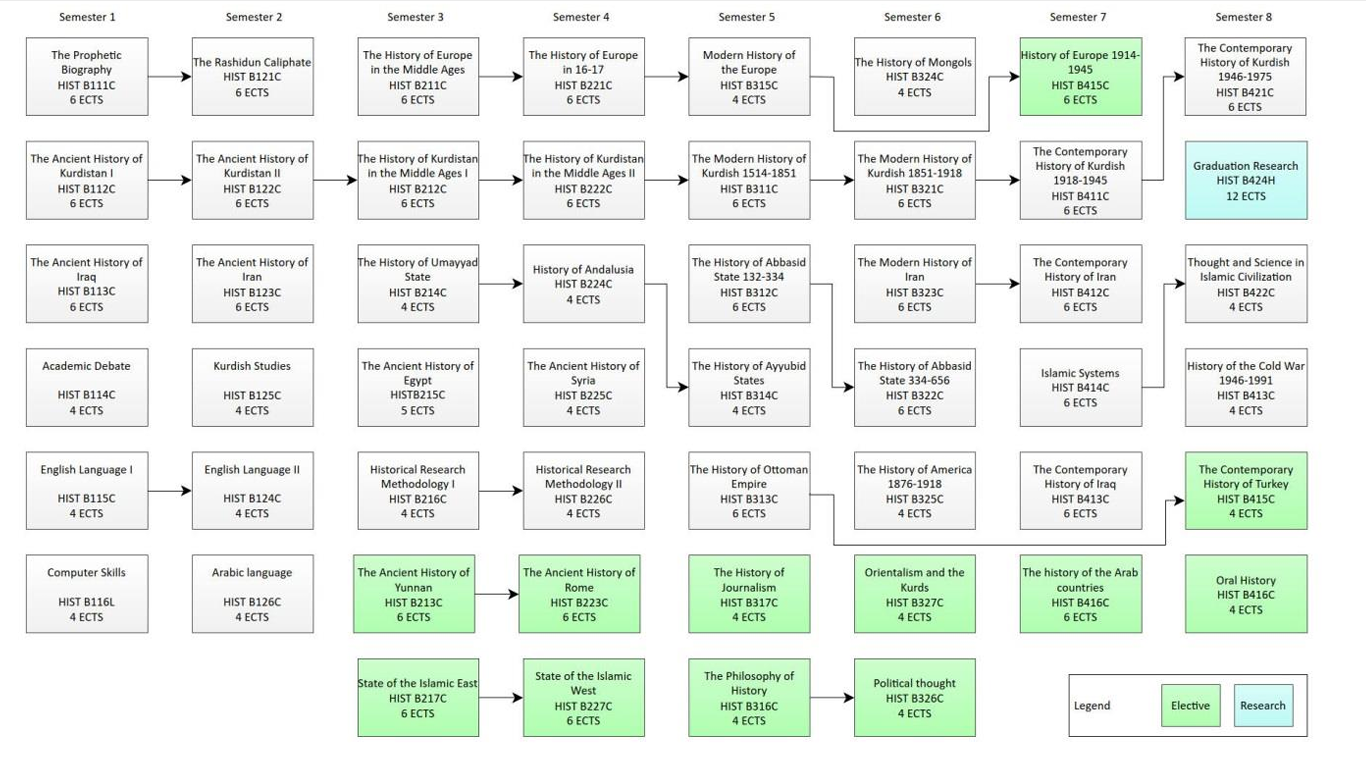
Programme structure diagram with credits
Yearly Timeline
Sept. 1, 2026
⚠️ First year students start around mid-October
⚠️ First year students start exams around 20 of January
July 1, 2027
Check out the full academic calendar on UoD's webstie.
Programme Coordinator

Assistant Professor in Ancient History
History
College of Humanities
University of Duhok
Apply to the Programme
Public undergraduate admissions in the KRG region are managed centrally by the Ministry of Higher Education through the online ZankoLine portal (regayzanko.com). After Grade 12 Baccalaureate results are released, high schools provide students with unique login credentials to rank their preferred universities and B.Sc. majors during a 10–14 day registration window. Final placement is automatically determined by the student's Grade 12 average, subject choices, and department capacity.