
B.Sc. in Geography
Program Profile
The Department of Geography was established within the College of Humanities in 2005. Its first and main academic programme is the Bachelor of Science in Geography. The programme welcomed its first cohort of students in 2005.
The programme is designed and regularly reviewed to meet the current and future needs of the Kurdistan Region and Iraq for qualified geographers capable of studying and analyzing natural and human phenomena and managing environmental resources.
The curriculum provides a balanced foundation covering physical geography, human geography, regional geography, and Geographic Information Systems (GIS). Practical sessions and field trips further strengthen students’ spatial analysis skills, teamwork, and field-based technical abilities.
The graduation project is a major component of the programme, promoting creative problem-solving and effective teamwork in geographical studies. Field training and practical visits offer students valuable opportunities to apply their knowledge in real-world settings, strengthen connections with the local community and research institutions, and help academic staff address regional community needs through students’ graduation projects.
Additionally, the programme includes a range of elective courses, allowing students to tailor their education according to their interests and the evolving demands of the geography job market.
Occupational profiles of graduates
Graduates of this programme possess a strong background in both physical and human
geography, supported by practical skills in GIS, remote sensing, fieldwork, and spatial analysis.
This combination enables them to interpret environmental patterns, analyze spatial data, and address real-world geographic challenges. Their training prepares them to work across governmental, environmental, academic, and private-sector institutions, with the ability to adapt to emerging trends in climate studies, land-use planning, and geospatial technologies.
Typical career paths include:
- Geographer / Spatial Analyst: Conducting spatial analyses, preparing thematic maps, and interpreting geographic data for environmental and urban applications.
- GIS Specialist: Designing, managing, and analyzing geographic information systems in sectors such as planning, environment, transportation, and natural resources.
- Remote Sensing Analyst: Using satellite imagery and aerial photos to monitor environmental changes, land cover, and climate-related patterns.
- Environmental Planner: Supporting sustainable development, evaluating environmental impacts, and contributing to land-use planning and natural resource management.
- Climatology / Meteorology Assistant: Analyzing climate data, identifying long-term trends, and contributing to weather- and climate-related research.
- Field Researcher: Conducting surveys, collecting environmental and socio-spatial data, and supporting scientific studies.
- Consultant / Project Assistant: Working with governmental agencies, NGOs, or private companies on projects related to environment, climate adaptation, disaster risk management, and regional development.
Qualification awarded
Bachelor of Science in Geography
Length of programme
4 Years
Number of credits
240 ECTS credits
Mode of Study
Full time on campus
Read more about the programme
Get detailed information about the programme requirements, courses, credits, and educational objectives as a PDF file.
Program Educational Objectives (PEOs)
The Educational Objectives of the Geography Program are to prepare graduates who are
able to:
- Analyze and understand natural and human geographical phenomena, applying geographical knowledge to address environmental, social, and regional challenges effectively.
- Demonstrate critical thinking, scientific communication, and teamwork skills, enabling them to collaborate with multidisciplinary teams in research, planning, and resource management.
- Contribute to community and environmental development by providing sustainable solutions while considering the social, environmental, and political dimensions of geographical decisions.
- Engage in lifelong learning and research activities through advanced studies, field training, and participation in research projects, in order to expand knowledge and keep pace with developments in geography and regional planning
Program Learning Outcomes
After successfully completing this program, students should be able to:
- Analyze and understand natural and human geographical phenomena, applying geographical knowledge to address environmental, social, and regional challenges.
- Apply geographical and planning methods to provide practical and sustainable solutions, considering environmental, social, economic, and political dimensions.
- Communicate effectively with diverse audiences in academic, professional, and community settings.
- Recognize ethical and professional responsibilities in geographical research and decision-making, while considering the impacts on society, the environment, and regional policies.
- Work effectively within multidisciplinary teams, demonstrating leadership, collaboration, goal setting, and execution of field and research projects.
- Develop and conduct field studies and geographical investigations, analyze and interpret spatial and environmental data to draw accurate scientific conclusions.
- Acquire and apply new knowledge as needed, using modern learning strategies and advanced geographical technologies to keep pace with developments in geography and regional planning.
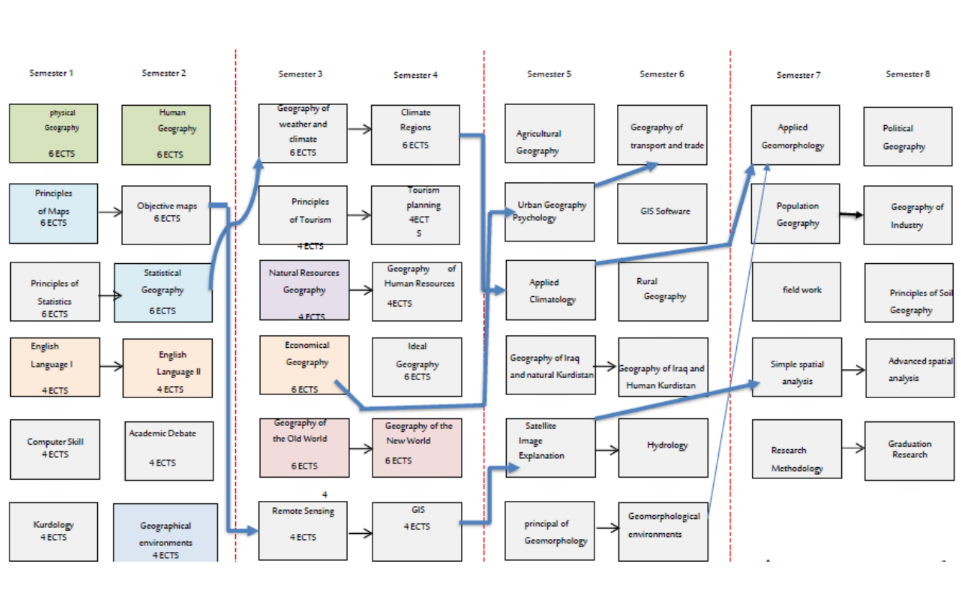
Programme structure diagram with credits
Yearly Timeline
Sept. 1, 2026
⚠️ First year students start around mid-October
⚠️ First year students start exams around 20 of January
July 1, 2027
Check out the full academic calendar on UoD's webstie.
Programme Coordinator

Lecturer in Geomorphology and GIS
Geography
College of Humanities
University of Duhok
Apply to the Programme
Public undergraduate admissions in the KRG region are managed centrally by the Ministry of Higher Education through the online ZankoLine portal (regayzanko.com). After Grade 12 Baccalaureate results are released, high schools provide students with unique login credentials to rank their preferred universities and B.Sc. majors during a 10–14 day registration window. Final placement is automatically determined by the student's Grade 12 average, subject choices, and department capacity.